
CME – What is cystoid macular edema
What is CME? When multiple cyst-like spaces form within the macula and result in swelling of the retina, a patient […]
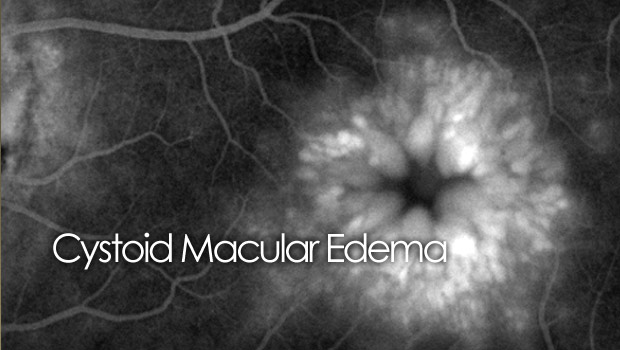
CME – What is cystoid macular edema
What is CME? When multiple cyst-like spaces form within the macula and result in swelling of the retina, a patient […]
What is CME?

When multiple cyst-like spaces form within the macula and result in swelling of the retina, a patient may be diagnosed with cystoid macular edema or CME.
This painless disorder is often discovered after a patient has complained of increasingly blurry vision, especially when reading (deterioration of central vision). Peripheral vision is usually not affected.
The most common reason someone might develop CME is if they have had recent eye surgery. Other causes of CME include diabetic retinopathy, uveitis and retinal vascular disease. In these cases, it is not uncommon for patients to experience swelling of the retina.
What is the macula?
Also see “Interactive Human Eye” animation
The macula is a part of the retina, the light-sensitive layer of tissue at the back of the eye that is similar to film in a camera. As you read, light is focused onto your macula.
Within the macula, millions of cells change the light into nerve signals that are sent to the brain where they are converted into an image. The macula is where we get our central vision. With it, we are able to read, drive, and perform other activities that require fine, sharp, straight-ahead vision.
CME Treatment
The treatment of cystoid macular edema may include one or more of the following:
- Anti-VEGF medications like Avastin, Lucentis and Eylea can reduce CME significantly, but are not always viable for insurance coverage reasons
- Ocular steroid eye drops to decrease swelling
- Injection of ocular steroids around the eye to reduce swelling
- Oral anti-inflammatory medicines
- Surgery to remove excess fluid (vitreous) from the center of the eye (vitrectomy)
The good news
With currently available treatments, more than half of all patients diagnosed with CME can expect significant improvements in their visual acuity after treatment. Treatment can take up to a year for full effect.
See also…
“Interactive Human Eye” animation
Intravitreal Kenalog Injection
Optical Coherence Tomography – OCT